

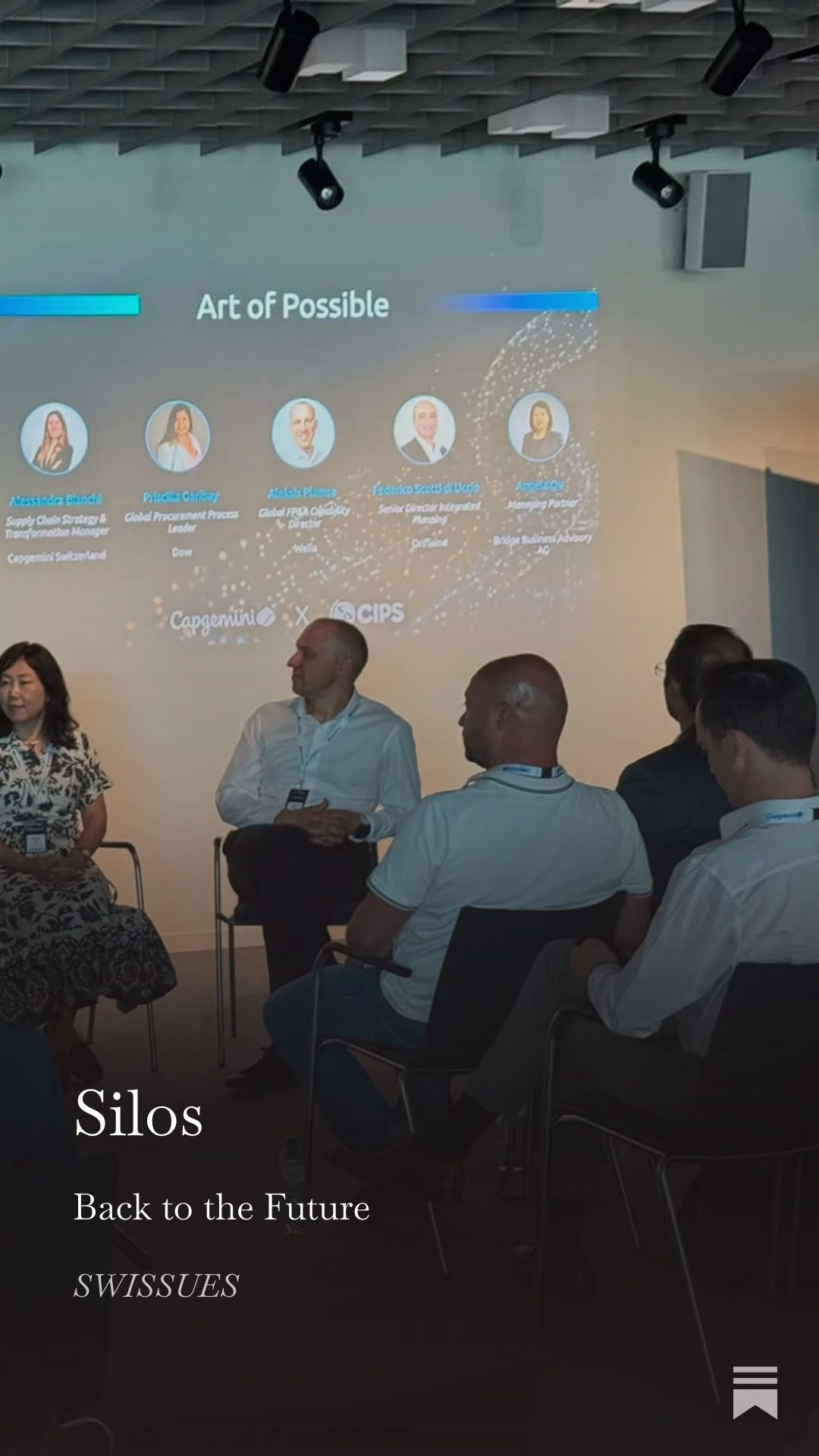
Aleks Sidorec invited me to a CIPS Switzerland/CapGemini event, ‘The Invisible Supply Chain’, in Zurich. Unusually for such an event, speakers and panelists all agreed on a single, striking diagnosis of the problem with artificial intelligence (AI) in supply chains. The reason they are not ready for AI is lack of coordination, failure to agree priorities, poor communication, weak integration and inconsistent data. In short, the problem is silos – the inability of functions to work together.
These were twentieth century problems. We’d solved them. They were over, gone. Manufacturing, Technology, QC, QA, Procurement, Engineering, Finance, Operations and Planning would get into a room with the Supply Chain (SC) Manager as facilitator and work through the issues. Targets were set by the Operations Director. Line managers of the respective SC Team members were informed about their objectives. Job done. No fuss.
Why are silos a problem again in 2026? And how am I going to face my colleague, Markus Hoerr?
Markus tried to warn me about this. Many times – beyond my point of exhaustion and impatience. He argued long and repetitively that functional silos make supply chains unworkable. He said that silos are so ingrained into business operations – and self-protection so much part of the culture – it is pointless trying to build AI tools and technology into the present system. It is too broken. He argued that AI has to replace the system, not augment it. I told him he was mad.
That was then. After last night, I think differently. Silos are back. And something has changed since Markus last harangued me about them. It is easier now to see how current management structures could be swept away and replaced by agentic AI. How a system could continuously create and optimize SC options. How it could monitor resilience and adapt to events. How it could implement change.
What an interesting event ‘The Invisible Supply Chain’ turned out to be.
Thank you Aleks.
Sorry, Markus.