

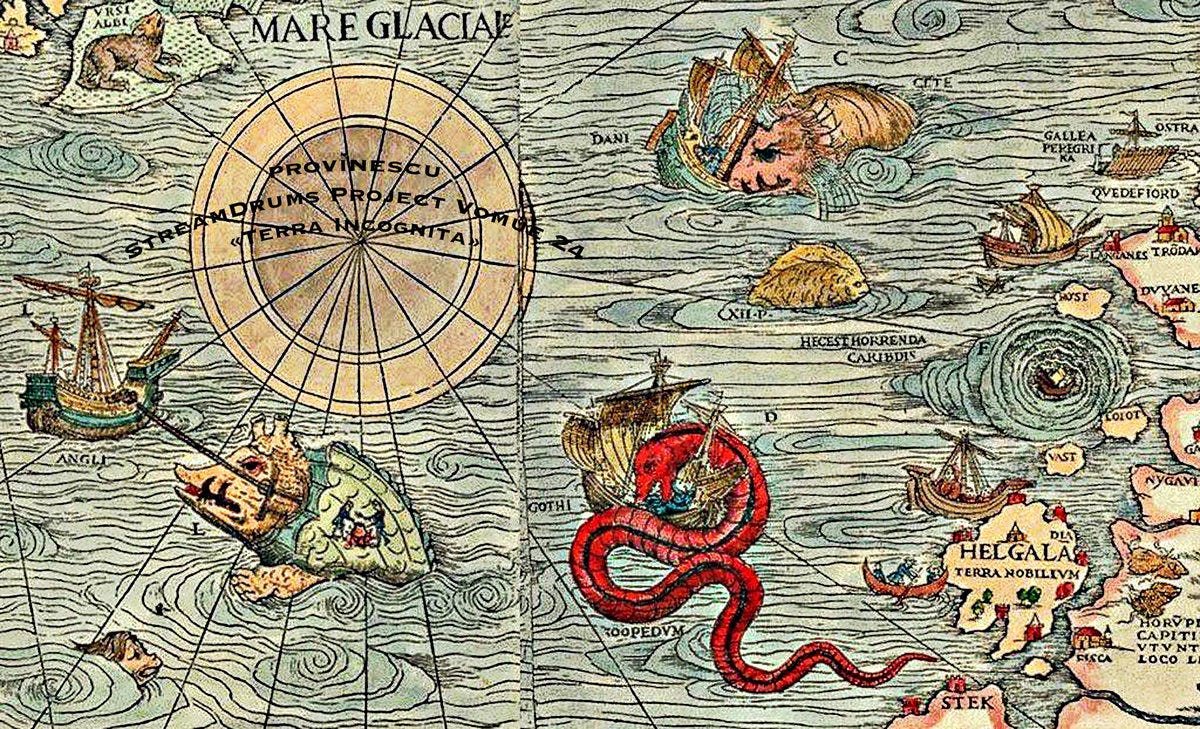
Medieval charts are famous for showing Terra Incognita between the boundary of known lands and the end of the world. It was supposedly populated by scary sea monsters and dragons but these were never enough to deter explorers with imagination and courage.
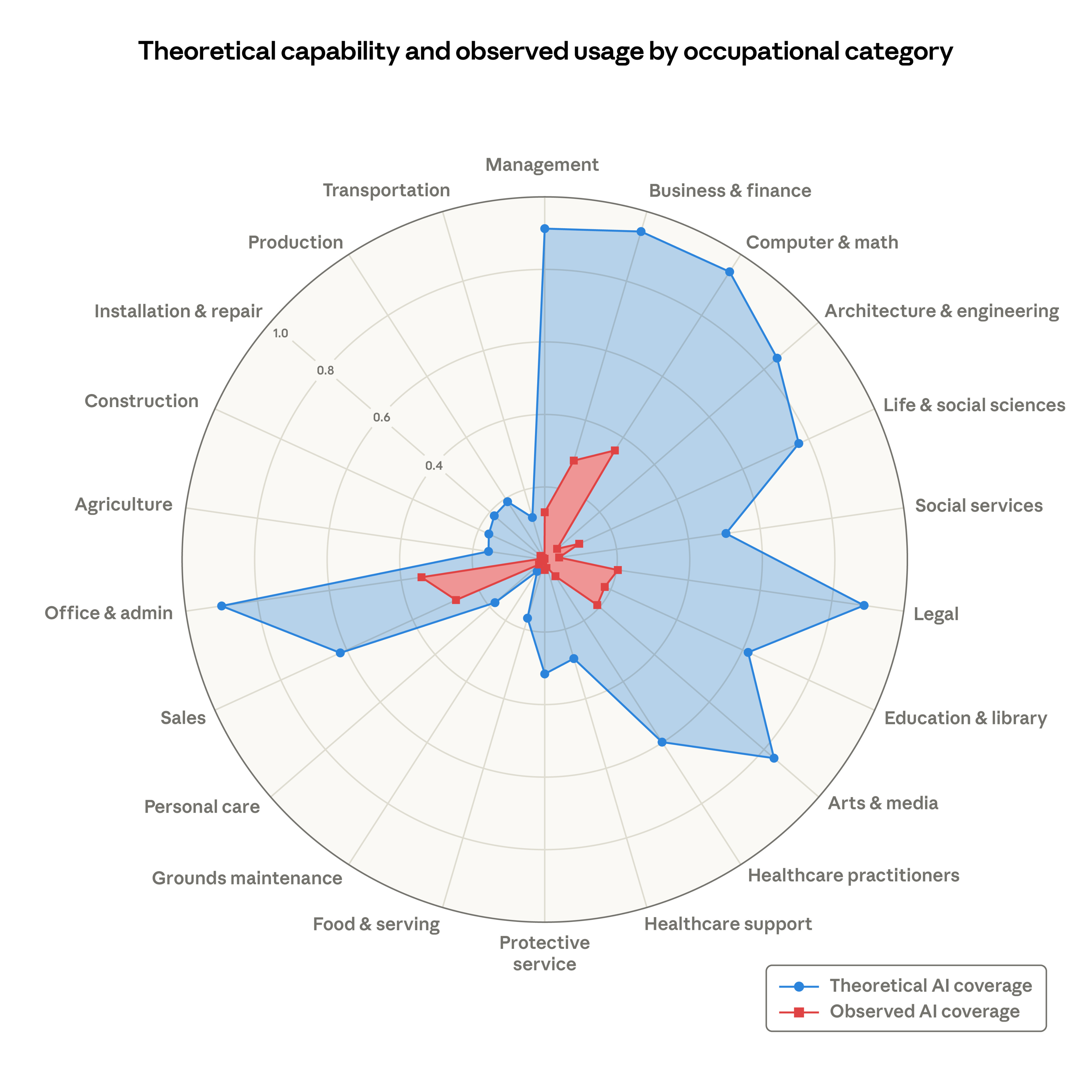
There is another chart — produced by Anthropic and circulated recently on Substack by Aleks Sidorecs — that shows a different unknown land. This Terra Incognita is the land between a line that traces what AI could do, and another showing how it is actually being used.
Last week in Basel, at a well-attended CIPS Switzerland event, that unexplored land was on display. Not however as a central topic of discussion.
Consider what Marcus (not his real name), an attendee, described over the buffet afterwards.
He had recently been given a market-research assignment as part of a job application: analyze several real companies, named in the brief, and propose how his prospective employer might engage with them. The assessor expected the usual — some LinkedIn trawling, perhaps a few analyst summaries.
Marcus fed the brief to an AI. He asked it not only to fill in the missing data but to locate internal reports, financial assessments, and public filings, and then to reason about how these organizations would likely interact with each other — and with his would-be employer. The assessor, confronted with the results, took them straight to senior management. The reaction was not admiration. It was disbelief. Not that Marcus had done something clever, but that this level of insight was available to anyone who cared to ask for it.
That is the unknown land. Right there. It is a territory businesses are not seeing
Earlier in the evening, a speaker — Ben Karer — had tried to crack it open from the stage. He asked the audience to imagine AI not just tracking a shipment but locating one that had failed to arrive; then finding a better route to prevent a recurrence; then proposing a better supply chain strategy altogether.
He stopped there. But he needn’t have.
The next step — the one that matters — is this: a supply chain operative, sitting at her terminal and tasked with ensuring on-time delivery, can within an hour explore strategic questions that would normally take months to percolate through four or five levels of hierarchy before reaching anyone with the authority to consider them. Some organizations will respond to this by restricting data access, introducing governance layers, slowing the signal. That response mistakes the symptom for the disease. The problem is not that the operative has too much access. It is that the organization cannot yet imagine what to do with what she finds.
These were the exceptions at the event. The main themes of the evening were something else entirely: clean data, knowledge storage, cybersecurity hygiene, AI literacy in hiring. All of it useful. All of it pointing toward problems already on someone’s desk.
The speakers — mostly consultants and solution vendors — can be forgiven. They are paid to solve problems people have today. The audience confirmed the wisdom of their approach to AI for vendor evaluation, process improvement, CV screening and other known tasks . The practical near-term is genuinely important.
But here is what was missing: any acknowledgement of the distance between “AI for CV screening” and “AI that restructures your competitive position before your competitors have noticed the shift”. It is not a question of budget or IT capability. It is a question of imagination. And imagination is not a technical problem.
The standard reassurance — that this technology wave will be managed like previous ones — is not reassuring. What distinguishes AI is not its power in isolation, but the speed at which new entrants, companies that incumbents have never thought of as competitors, can use it to redraw an industry’s boundaries entirely. The organization carefully governing its internal AI deployment may find that the more consequential deployment happened outside its walls, on someone else’s initiative, last quarter.
The Terra Incognita in Anthropic’s chart is not just a technology adoption curve. Failure to explore it is not through the fear of dragons. It is down to a lack of imagination.