

Why Old Economics Fails and What Might Replace It
J. Doyne Farmer’s book is dense, chaotic, and occasionally brilliant. Here’s the real point behind the math.
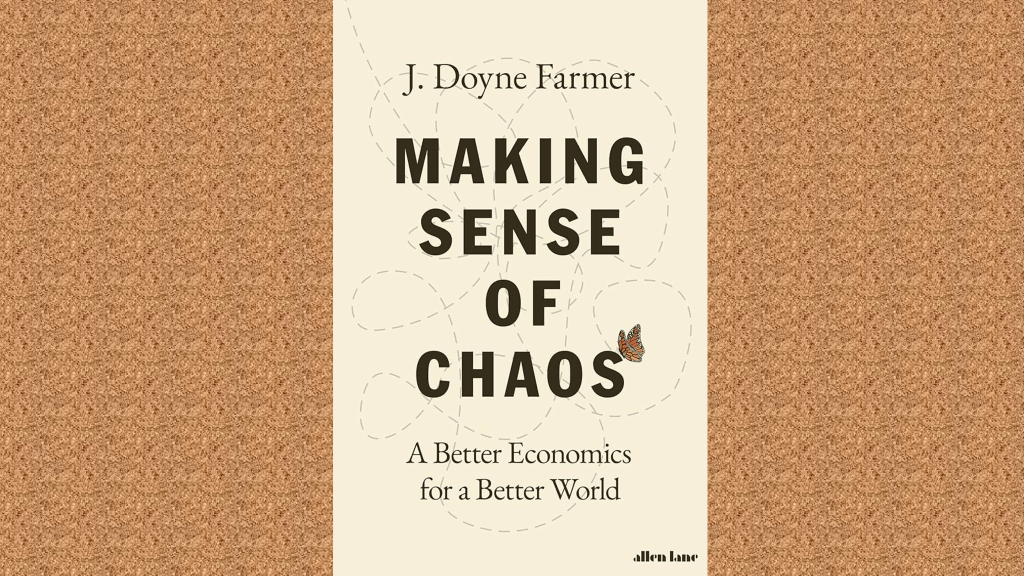
The title is well chosen — not just for the subject matter, but for the book’s style. Making Sense of Chaos is a whirlwind of anecdotes, theories, economic history, scientific digressions, and personal reflections from the author’s unusual career. Somewhere within this blizzard lies a clear and important idea — but it’s not easy to find.
J. Doyne Farmer is a physicist turned economist, and this book reflects that journey. He explores cybernetics, complex systems, self-organizing structures, and the evolution of economic thought, often taking detours into the careers of researchers and the history of ideas. The result is intellectually stimulating, but at times overwhelming. Many readers — judging from other reviews — struggle to finish it, or finish unsure what its main point was.
So let me attempt to say what I think the conclusion is — at the risk of oversimplifying a complex argument:
Economics, since the 19th century, has tried to quantify human behavior. Following Adam Smith’s Wealth of Nations (1776), economists sought to make the idea of the “invisible hand” measurable. The result was a set of so-called analogue-based models — equations that describe economic behavior in smooth curves. Think of a demand curve showing that as prices fall, sales increase. These models are elegant and easy to work with, and they often match historical data reasonably well — but they’re poor at predicting the future.
The problem is realism. Analogue-based models assume a single, average customer whose behavior changes smoothly as conditions change. But in reality, markets are made up of many different types of buyers, some of whom behave unpredictably — even irrationally — and influence one another. Some buyers only appear when prices fall; others, surprisingly, drop out. In short, human behavior isn’t smooth. It’s messy, interactive, and diverse.
To capture this complexity, we need a different kind of model — one that simulates individual behaviors, group interactions, and emergent outcomes. These are known as agent-based models. Until recently, they were too computationally intensive to be practical. But now, thanks to modern computing power, they’re becoming viable — and they offer a radically better way to understand economic systems.
That’s the real promise behind Farmer’s subtitle: A Better Economics for a Better World. Agent-based models can help us design policies that account for inequality, instability, and systemic risk — things traditional models often overlook.
This book is valuable not just for its argument, but for what it represents: a turning point in how we model human systems. For non-experts, it offers just enough background to start asking better questions — especially when faced with economic models or policy recommendations. But be warned: you may need to fight your way through some chaos to find the clarity.
The post From Curves to Chaos appeared first on SWISSUES.